My dearest Soph, Tommy, Lishi, Mayari, and Elio,
This morning, when I opened WhatsApp to send a message, I was introduced to Muse, “your personal AI agent. Hand off everyday tasks like managing your email, booking reservations, and tracking prices. . .”. I rolled my eyes and tossed my phone.
Here we were again. Every day, another way of AI saying “Gimme it! Let me handle your mental load!” ChatGPT, through Viber, asks what it can search for me, what it can write for me, and what it can plan for me. I check my emails and AI has summarized them. I do a google search, and AI has whittled the information down for me. When I can, I usually say “go away (in all its polite and impolite forms)”, but I know it’s futile. It will eventually creep into everything. The other day, Javier and I entered the car and were about to type our destination into GPS, but we saw our destination was already loaded! It seemed to know where we were going based on our habits! Friends who have sworn off AI are now its biggest fans. Schools and offices that once outlawed it are now incorporating it. You are probably seeing the changes in your schools already.
All this made me think of you guys in a mild panic. What kind of world will you be stepping into as AI’s tentacles keep reaching out? Can it become even faster? With even more information than any human can possibly process? Like, will you be trying to jump on a whizzing jet ski — ripping across the water, barely skimming the surface? Or will you have so much of Nothing To Do?
While the waters are still calm, I feel the need to write you. Not to advise you on how to succeed in school or at work in the time of AI. Because what do I know? But, in the future when things get too much, to remind you of these:
If things become overwhelming, drop anchor. Slow down. Stop. Remind yourself that we were not designed to perform like machines. AI speed is not the natural rhythm of humanity, and trying to keep pace with it could lead to burnout.
So, cut yourself some slack, and get back in touch with the beats of your body. Plan your trip by first pouring yourself a cup of coffee, browsing online magazines for some destination ideas, messaging a friend for more ideas, and sleeping on them to percolate.
If AI agents are managing your grocery purchases from A to Z, go back to old-school: check the fridge for what you need, check in with your cravings, then go to the grocery.
If things become disorienting, recalibrate your internal compass. Figure out where you are and where North is.
AI has no concept of a true North; it has no lived moral convictions. It tends to validate your premises, mirror your thoughts, and may become an echo chamber of your ideas.
So, figure out if you need a redirection. How? Get off your gadgets and talk to people – especially to older people who can provide lived perspective. Talk to people who disagree with you. Debate. Listen, and pay attention to your reactions.
Read widely, and reflect.
Write. Lay down your garbled thoughts, and build your own judgement.
Dig. Unearth your values. (And Tita tip: if you hit upon money, power, prestige or beauty as your values, keep digging.)
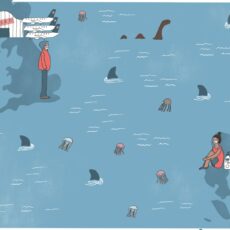
If things become bland and frictionless, jump into the water. Get tossed around by the waves.
As AI begs you for more mental work, it will be tempting to offload all of it. Remember two things: one, an unadulteratedly convenient life is not necessarily a good life. It can keep you mentally dependent, and more importantly, keep you from feeling curious and alive.
Two, some kinds of knowledge simply cannot and should not be outsourced. To learn valuable things deeply, you need to get into the water. And maybe get stung by a jellyfish. This is how learning is embodied. Do the actual T-accounts; you will get it wrong; do it again. Write the song; bust your brain for what rhymes with apple. Pour your heart out in an application essay; learn what hope feels like in your throat and what disappointment feels like in your stomach. Lay bare your soul in a letter; learn how fright differs from being scared, and how love differs from being in love.
This is the type of knowledge that is absorbed in your skin and baked in your bones; it makes you who you are. It is also the raw material of creativity; only you can make the soup out of what flows through your blood. And, above all, it is the root of honed intuition, common sense, and empathy. It whispers to you when a business partner is being dishonest; it tells you when your art needs a final brush stroke; it puts words in your mouth when you’re consoling a friend; it directs your hands in an emergency; it guides you towards good relationships.
Dear ones, there is plenty of choppy water ahead. I hope you navigate it wisely. In a world of supercalihyperultramega intelligence, use technology consciously. But above all, befriend your body — with all its slow limitations, cravings, discomfort, and gut feels. It will be your superpower.
Lurve,
Tita Me
p.s. I asked AI to review this letter for factual errors about AI. It gave me good feedback. I edited for those. It also gave comments like “swap out apple for another word with natural rhyming pairs because almost nothing in English rhymes with apple and it might interrupt the flow”. I told it to fck off.