wingwmn

spreading my wings and sharing random lessons learned along the way

  • About
  • Life
    • Life
  • Curiosities
    • Design
    • Travel
  • Articles
  • Subscribe

Life

Space, Magnets, and What We Inherit: A Love Story

By wingwmn · Follow: InstagramMay 16, 2026

I entered my parents’ hotel room to much ruckus. Dad was sitting on Mom’s side of the bed in his street clothes. Mom was yelling from underneath the covers something to the effect that he was dirty and needed to change OR ELSE we weren’t going out for dinner. Typical scene, I thought, in that Mom was quibbling. Atypical in that Dad was practically lying on her, giggling, and trying to get her goat.

The next day, Dad was in a coma. That hotel room scene kept playing in Mom’s head. “We were quarreling,” she kept saying.

Last week, on what would have been their 55th wedding anniversary, she remembered their squabbles. “You know, I was constantly picking fights, but he rarely fought back. He just ignored me. It actually was no fun.” She laughed. “I regret fighting him so much.”

“That was how you loved him, Mom. And he knew that.”
__

Because of the kind of person Dad was (a childlike genius of a lovable man, but childlike nonetheless), Mom had to take charge of things that Dad refused to care about.

Because Dad had zero vanity, Mom had to be vain for him — a tough job for the wife of a public servant (operative word: public). She had to run after him about shaving, following dress codes, wiping sauce off his mouth. Because Dad had zero interest in being healthy, Mom had to be the health police — supervising his intake at parties, making sure he took his medicines, coaxing him onto a treadmill. The list of Mom’s responsibilities went on.  

Dad usually offered some resistance — a shout here, a whine there — but he always eventually caved.  As long as she didn’t meddle in the things he cared about (his work, his projects), he would acquiesce.

Like opposite poles of magnets that pull together, Mom had to close the gap between them. To take care of him, she encroached and latched on, not necessarily in a tender embrace, but in a martial arts clinch. Mom taught us to do the same. At parties, she’d beckon and say, “Your Dad is on his 5th glass of wine. Go.” And like little rottweilers, we’d go and take the glass from his hands. “Your Dad has been in front of the TV for hours,” and we’d pull him off the couch and drop weights in his hands.

When we would switch allegiances (as we’d often do) and say, “Mom, just let him have his beer”, she’d snap, “You see? You don’t love him. You don’t care if he gets sick.”

It was clear: to think for him, to worry for him, to overwhelm him — that was how she had to love Dad.  
__

A few Christmases ago, my whole family descended upon Madrid for the holidays. My partner, J, and I stayed in the hotel with them for 2 weeks. On Christmas Day, as we were getting ready to head back to the hotel after a lunch in J’s suburban home, J said he would stay to hang out with his nephews. He’d see us tomorrow. 

At breakfast the next day, my Mom said “You know, Ani, I was thinking . . .you did the right thing. You gave J his space.

It’s important that you give him freedom to do his thing while you do yours. Since you’re both well-baked in your own ways. Over-baked, in fact.”

“Although,“ she continued, “if your Dad tried that on me, I would say over my dead body.“
__

My sisters and I often talk about this expression of love we’ve inherited — how we think it perfectly normal to be in our partners’ faces. How there is something comforting and secure about not having to ask permission to meddle. How love can be expressed as barging in and taking charge.  And why on earth our partners, unlike Dad, just don’t get it?

The other day, J gestured, “You have something in your hair. Do you mind if I pick it out?”  I rolled my eyes, “duh”. 
If he had mayo on his nose, I’d  swipe it off without a second thought.

When he isn’t a fan of what I’m wearing, he says, “It’s not my style.  But you still look beautiful, so you do you.”
If I don’t like his outfit, I shriek NOOOO. NO. NO. NO, then take a picture and get my family to back me up.

When I ask him to wake me up, he tiptoes into the room, barely strokes my arm, then whispers apologies for having to wake me.
I wake him up with a marching band.  

These differences have caused friction. I’ve had to adapt.

When he says he wants to spend Christmas with his family, I hold back on my instinct to remind him that my family is here for only 2 weeks. Instead, I recognize the loyalty he has for his family that I have for mine.  When he holes up in the basement for hours to build a shelf, I resist the urge to pull him out and demand that we spend time together. Instead, I recognize the need for uninterrupted creative flow that I crave for myself.

And as with two magnets of similar poles, I push away — not in repulsion, but in respect for his personal space. I am learning that in this particular relationship, the strongest expression of love may be biting my tongue bloody.
Emerging from Uranus: A Birthday Reflection

By wingwmn · Follow: InstagramApril 30, 2026

Hiii Dear Friends!

Three days ago, I turned another year older. I celebrated by getting cataract surgery because at this age, I’ve started to run out of ‘birthday adventure’ ideas. (Although please note, I am not quite cataract-years old yet; cataracts were the byproduct of chemotherapy.)  All that to say, please forgive me if I have not responded to your greetings. I literally have not been able to see them.

___

I recently learned from my astrologer friend, Ria, that as a Taurus, I (along with Aquarius, Scorpio, and Leo) am coming out of an eight-year horrendously rough patch. Other than what is currently on my left eye, I didn’t even know I was involved with any kind of patch.

A quick Google search revealed that in May 2018, Uranus entered Taurus essentially causing a major shit show (pun intended).  

Let me attempt an amateur astrological explanation: Among the zodiac signs, Taurus thrives on stability and comfort. As a Fixed Earth sign ruled by Venus, the goddess of love and beauty, she burrows into an aesthetic-focused life filled with sensual pleasure and stays there. She does not do well with change.

Uranus, on the other hand, is the planet of radical change, disruption, and rebellion. Uranus is antithetical to Taurus, and yet in 2018, Uranus entered Taurus’s sanctuary with his celestial wrecking ball and sowed disorder.

___

I assessed the past 8 years in light of what Ria said. Uranus was certainly present. Every time I tried to build something, it got knocked down.

Retirement: In 2018, I had just retired from New York corporate life to explore the world and my interests. That same year, my Mom was diagnosed with metastatic breast cancer. Instead of traveling far and wide, I stayed close to home.  

Love in Covid: In early 2020, my relationship with my partner, J, had barely grown roots. I went home to Manila for what was supposed to be a two-week trip only to get locked down and away from J for two years.  

Illness and Death: In 2022, I moved to Spain to be with J. I had barely settled into my new life when I received a cancer diagnosis. Treatment yanked away my hair, my youthful skin, my eyesight, and the vestiges of my vanity.

As soon as I finished my cancer treatment in 2024, we learned that Mom’s cancer had spread to her brain affecting her mobility, speech and memory. 

Then in 2025, Dad died.  

Uranus was relentless. 

___

Anyone who knows me knows I am no Pollyanna. However, as I scanned the past sniffing out Uranus (okaaay, I’ll stop with the puns), I also saw the steady grace of Venus.

Despite her diagnosis, my Mom remained unstoppable. She pestered her doctors into prescribing a protocol that would allow her and Dad to travel. And as a new retiree, I had the freedom to travel with them. How we traveled — to India, to the Mediterranean, and to Turkey and the Holy Land — in between her treatments!

The long-distance challenges with J meant that I met him in the first place!  I was struck by his steadfastness. On our second date — the night after our first — he invited me to Tenerife for the holidays. I messaged my Mom, “I’m not coming home for Christmas. I met a really good guy.”  She responded, “Stay as long as you need to. Just bring home the bacon.” 

After the initial shock of my own cancer diagnosis, I immediately found peace. Family and friends near and far, old and new, carried me through. My mom was my inspiration for addressing each side effect with deft nonchalance.  One day, I had just stepped out of the house when my nose gushed all over my shirt. Unruffled, I texted my friend, “Sorry, slight delay. Nose bleed!”  I lay down, waited for it to pass, tossed on a new shirt, and messaged “Lezzgo!”

When Mom’s cancer reached her brain, her Filipino doctor told her, “I’m not giving up on you,” even when her Singapore doctor had.  The new drug he prescribed restored most of her speech and all of her wit.

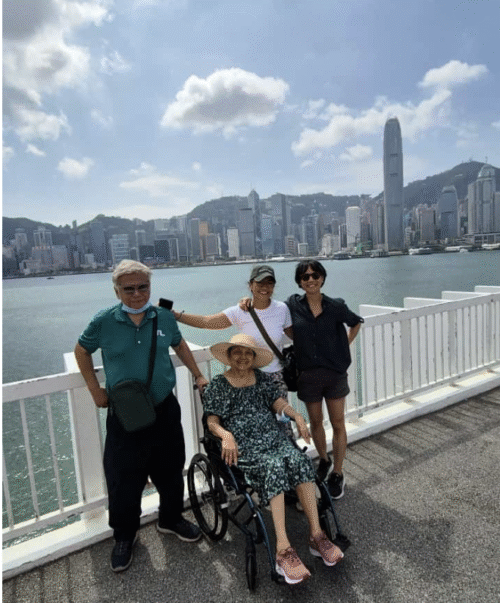
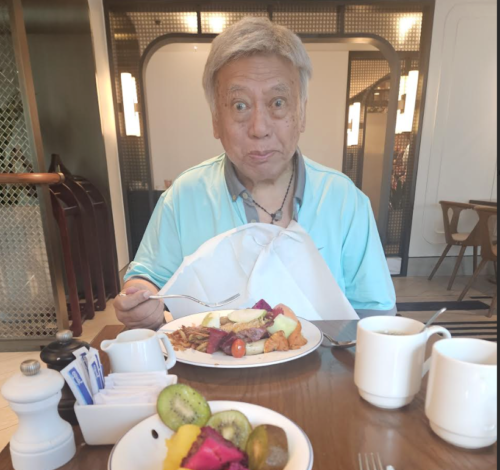
Before Dad died, we got him to Hong Kong for roast goose.

___

Uranus has left Taurus. As dust from the wreckage settles, foundational truths emerge: 
That there is no such thing as stable ground. Life is change, and it is folly to believe otherwise.  
That earthly pleasures can be temporary balms; but lasting peace is found in contemplating loss and death.
And that even during times of upheaval, there is room for Venusian tenderness, mercy, and humor. 

May my newly de-cataracted eyes never lose sight of these.

Thank you for your birthday wishes. 

Love,
Me

Heavenly Birthdays

By wingwmn · Follow: InstagramMarch 15, 2026

Hi Daddy,

Do you remember this time last year — when we pulled off the miracle of birthday miracles? You were in the ER in the wee hours of your birthday for a stomach ache that doctors thought was a heart problem. Mom was six floors above you, on her fourth night of confinement for an infection. Lex and I were on the phone at 3am agonizing over your conditions, and over whether we should cancel your party scheduled for that evening.

But lo and behold, you were discharged 7 hours later. Mom was discharged shortly after. And we went forth and partied.

While you were chatting with your friends, Lex asked you to sing. You curtly replied, “Don’t bother me.” We laughed. We were just drunk with happiness that we were able to celebrate. Why do the sweetest miracles only bloom out of pain?

That was your last birthday. I wonder; if you knew that it was your last, would you have done anything differently?

I know that I would have. And it’s not even the big stuff that I regret, but the small, easy stuff.

One particular instance comes to mind: I had just arrived from Madrid and had less than 24 hours to run errands before we left for Hong Kong. You were napping, in the strangely amazing way you do, at the dining table — head erect and unsupported but fast asleep. I was rushing to my room to send some emails. I saw you and thought of startling you awake with a hug. But I decided against it because I knew you would sit me down to chat and delay me. And I was busy.

Two days later, you would be gone. i regret that missed hug so much. Why are the most important lessons learned so painfully?

The thought of you gone still stings. But this pain of missing you just means that you came (on this day 87 years ago)! And that our lives intersected! What a sweet, blessed miracle that I will always be grateful for.

I know you’re again surrounded by your friends, Dad. And I also know that now, you’re finally singing your ethereal lungs out.

I love you forever,
Ani

p.s. Mom is amazing. But you already knew that.

Fearlessness: A Lesson from Dad

By wingwmn · Follow: InstagramNovember 1, 2025

For someone so gentle and jolly, Dad was obstinately fearless in his convictions. Like a dog with a bone, if he felt strongly about something, he locked in and latched on at all costs.  

It amused me that in college, as a fresh-off-the-bus probinsyano, he ran for Ateneo student council president against a very popular, very skilled Manileño. Dad concentrated his campaign energy in the dorms where all the probinsiyanos lived, won their support and with it, the presidency!  He continued life like that, with his eye always fixed on the prize. Growing up, I nervously observed him make the leap from the business sector into the then very messy politics of his province. Hands over eyes, I watched him on TV debating heatedly and facing off against political opponents. And later on as an entrepreneur, he embarked on (often difficult) passion projects to bring development to his province: co-founding a university and co-building a resort in a remote, isolated village to jumpstart its economy.   

This doggedness was one of Dad’s traits that struck me most because, while I like to say that I am my father’s daughter (in face, sentimentality, nerdiness, and a proclivity towards introversion with flashes of social-animal), his guts of steel were in sharp contrast to my own, which are often tied in knots from overthinking things.

A few years ago, while we were discussing one of his bucket-list projects (to make a documentary on the Fall of Bataan), I challenged him: What about financing? (his answer: we’ll find!). Is there even a market for that film? (who cares?!).  Who will write, direct, and act in it? (me, me, me!). Then he paused and said, “Ani, if you focus on all these little obstacles, you will never begin. What’s the worst that can happen if you try?”

____

Recently, dad’s ambitions had become much simpler. All he wanted was to travel.  That was what he and Mom loved to do, but since Mom’s illness last year, they’ve been unable to. He yearned to travel with an ache that was palpable. Travel was always on his mind. Every day, he would ask “Mommyyy, when are we traveling????”

When I’d call, he’d say: “I want to go to Madrid! I want my jamon!  Have you been to El Botín?  I’ll go to Madrid, then we go to Barcelona. Then Rome. Then we can fly home via New York, Cincinnati, San Francisco . . .”

Some days, he’d say “Actually, I don’t like the jetlag anymore. Instead of flying east to west, we can go north to south.  Hong Kong for roast goose.  Then Korea. Then Japan. Then back home through Taiwan, and pwede rin Cebu!”

A few months ago, he came with me to the airport as I was scheduled to fly back to Madrid. At the airport, he jumped out of the car, grabbed my suitcase and marched ahead past the startled guard and through the doors of the airport.  I laughed, “where are you going?” He replied, “I just want to go with you to the lounge.”  We could have probably gotten away with his antic — he can charm anyone — but I knew he wouldn’t be able to find his way back to the car alone. So I led him back out and promised, “We’ll travel when I come back in a few months!”

____

My Mom, sister Lex, the caregivers, and I all rallied; we did everything we could do to give Dad a trip. We chose an easy itinerary (Hong Kong), got the clearance from all doctors, and Mom worked extra hard on her physical therapy to join us because Dad didn’t want to travel without her.  But we knew the real risks remained.

And in the end, the absolute worst thing I could imagine happening happened. Dad suffered a massive stroke in the early morning of our third day in Hong Kong. We rushed him to the hospital where he lay unconscious and died almost 48 hours later.  

It was pure devastation. And to add to that, the extra layer of thick bureaucracy to get Dad home to his final resting place. 

And yet, I don’t think I would have done anything differently.  The absolute worst thing happened after we locked in on the prize, but Dad went happy — traveling, lounging, with his roast goose. This makes every inch of the pain worth it.

Having experienced the worst, my risk barometer has shifted significantly. I now understand that, in the larger scheme of things and in the pursuit of what matters to me, most risks are really ‘who cares?!’. With the breaking of my heart comes the steeling of my gut, a lesson only dear, beautiful, beloved Dad could have taught.

My Solo Journey. An Essay For Vogue

By wingwmn · Follow: InstagramJuly 15, 2025

I am very excited to share this piece I wrote for Vogue Philippines’ Wanderlust issue (July/August 2025). You can get a copy here.
*

This morning, while scrolling through my phone, I came across these posts on social media:

“I am a solo traveler who just returned from Australia. I love hiking, music, and history. I’d welcome like-minded travel buddies on my next trip.” – in a FB group chat for solo travelers

“Eager to see the world but nervous to travel alone? Come with me. We plan epic trips with a diverse group of solo travelers. We’ll meet as strangers but quickly become friends.” – an IG travel influencer

“I am traveling solo in Amsterdam. Any good recommendations?” – another IG influencer

Every day, I see similar posts that give me pause. They hint at a significant shift in solo travel, one that, for an old hand like me, is making me go “hmmm”. I started solo traveling at the turn of the century, when after a solo trip to Madrid with the goal of learning Spanish, I learned, not Spanish, but a love for the solo flight. Since then, I promised myself a solo birthday trip every year. Most years, I gifted myself more than one. I never bothered keeping count, but doing the rough math and thinking back on my journeys, I must have at least 30 solo trips to my name.

When I first started, solo travel was considered strange and dangerous behavior. Solo travelers were an anomaly. Restaurants didn’t know what to do with us so they seated us at the back tables. Other travelers threw us pitying looks. Apps like Uber, Google maps, and Google Translate did not exist. Neither did Opentable and Tripadvisor. I lugged around at least 2 guide books to every destination. I had to learn to speak, at the very minimum, the essentials of the language; and I had to learn to read physical road and public transportation maps. I also had to learn to strike up conversations with strangers, to eat in silence (I never learned to eat with a book), and to make do with the limited restaurant choices in travel guides or take risks. In short, solo travel meant preparing hard, and if the hard preparations didn’t work, learning to flow.

I watched the solo travel landscape transform through the decades. From an “odd hobby” pursued by an intrepid few, it started to bloom after the publication of Liz Gilbert’s Eat Pray Love in the early 2000s. I found myself fighting for slots in yoga retreats against a wave of women doing their own “eatpraylove tours”. In the 2010s, Instagramers and Youtubers shared their travel experiences in real time, further normalizing solo travel. And very recently since the pandemic, with remote work permitting freedom of location, solo travel has exploded. The 500-billion-dollar industry continues to grow at 15 percent annually and is expected to reach one trillion dollars in a mere 5 years.

Solo travel is a fundamental part of who I am. I might even dare say that I am who I am because of it. It has taught me to trust my inner chatter, to stay with discomfort, and to dance through rhythm interruptions. I once found myself stranded at sunset in the small town of Poggibonsi, in the middle of the Tuscan vineyards. I had missed the last connecting bus to San Gimignano from Florence. Hotel and transportation apps were non-existent at that time. Before I could enter a full meltdown, a rickety old car sputtered into the scene and stopped in front of the bus stop where I was stranded. An equally rickety old man stepped out, lit a cigarette and stretched his legs. I knew he was my only hope. After a few puffs, barely enough time for me to gather my courage and my Italian, he extinguished the rest of his cigarette and made his way to his car. I jumped at him, threw him my story in unconjugated verbs, and a minute later, found myself hitchhiking to San Gimignano. From that moment, I was invincible.

This is the beauty of solo travel. It is meant to yank us from our routines, make us uncomfortable, and shift our inner terrain. These events stir ripples of thought and emotion that typically go unnoticed in the presence of friends: nostalgia, anxiety, loneliness, fear, excitement, curiosity. It is these moments of raw experience that rouse latent aspects of ourselves, and give us the chance to witness them clearly without the bias of our companions. If we pay attention to these natural inclinations and take the time to understand what they reveal, we go home from our journeys having made an even more valuable inner journey. These could lead to profound life transformations, which for me, is the real gift of solo travel.

Which brings me back to my morning musings.

The benefits of solo travel are now universally recognized. Solo travel has become mainstream, and solo travelers are everywhere — in cafes, in hotels — they journey separately but side by side, enjoying safety in numbers. They no longer need to suffer pitying looks; they’ve become the cool kids. Through their phones, they are connected at any moment to the worlds they left behind. The travel industry caters to them, offering highly curated itineraries, meeting their existing tastes, and ensuring that they are comfortable, happy, safe, and mingling with like-minded travelers. In short, the rough edges of solo travel have been softened. The valuable ripples of new thought that are borne out of hard, non-quotidian, solitary moments have been muted. The success of solo travel has diluted the very essence that makes solo travel a transformative force.

I confess I have benefited from this softening — hotel and restaurant reviews help me make my choices, apps tell me how to get from point A to point B with exact time schedules, group chats with friends and family at home keep me from loneliness. Traveling solo has become so effortless, so comfortable, and so . . . un-solo. In fact, tethered to our phones, true solo travel (in the turn-of-the-century sense) is quickly becoming a thing of the past. For first-time solo travelers, this is a marvelous thing. There is no reason to be afraid. For the old-timers, however, my question is this: will we need to travel further and wider to find life-changing discomfort and solitude, or will we need to find other avenues of self-reflection in a more interconnected world?

*
Photo by Patrik Kapetan

Divine Humor

By wingwmn · Follow: InstagramMay 23, 2025

So, I’ve been cutting my own hair for a few months.

*
When you’re trying to grow out your hair from a pixie, cutting your own hair is a good skill to have. First, it saves time and money as you’re constantly having to guide your hair out of awkward stages. Also, it gives you the power to get the EXACT hairstyle you want without any lost-in-translations between you and your stylist.

(By the way, I live a block away from my salon. This means, when I walk up the block, I do strange things to avoid bumping into my stylist, Yolanda. Sometimes, I walk with my entire body angled away from the salon windows. Sometimes, I tuck my head into my collar. Sometimes, I run. And sometimes, I cross the street only to re-cross the street after one block.)

*
While cutting your own hair is a good skill to have, it is also a b*tch. Before you learn to get the cut you want, you first have to learn to “get the hang of it”: to understand that if you hold your hair at this angle, your hair does this. And if you cut it from this side, your hair does that. Meanwhile, you’re walking around with your trial-and-error sitting on your head.

*
I’ve considered going back to Yolanda. But I obstinately decided to keep going so that in the future, I will have the haircut of my dreams all day, every day.

*
And then…

The other day, while I was walking (verry far, about 20 blocks from where I live), I heard, “Anita!”

I looked around. Feck! Yolanda! What were the chances??

“Queee taaaal??? I have not seen you in aaages,” she said. Then she wagged her finger at the trial-and-error on my head. “THAT is not my haircut. POR FAVOR, Anita! Come to the salon so I can fix that!! POR FAVOR!!”

Oh how I laughed inside. I knew a divine message when it slapped me in the face. The universe was saying, POR FAVOR, stop with the ridiculousness.

*
The next day, I called Yolanda to set an appointment. When I hung up, these were the numbers on my phone. 11:11. The angels were celebrating the decision.

I snickered. Divine humor, I tell you.

On Trivia and the Universe

By wingwmn · Follow: InstagramMay 6, 2025

The other weekend, my partner, J, and I went on a roadtrip to Segovia for my birthday. While driving, J started with his romantic sweet nothings.

“Do you know that the universe always tends towards greater entropy?,” he says. (His love language is trivia).

I looked at him, “Ehhhh?”

“You know entropy, right? The level of disorder in the universe?”

“Aaaah,” I responded eloquently.

“Since the Big Bang,” he continued, “the level of entropy, or disorder, in the universe has increased. Over time, the universe just keeps getting more and more chaotic.”

“Nice,” I replied.

“Take a jar filled with two layers of colored sand,” he continued. “Blue at the bottom and white on top. Carry it around for a day. By the end of the day, the two colors would have mixed together. Without you taking tweezers to separate out the colors again, it will never return to its original orderly state. It’s the second law of thermodynamics. In a closed system, the universe naturally and incessantly devolves into greater chaos.”

This time, I let it rest.

Like, literally.

Like, I fell asleep.

*

The next day, I looked at myself in the mirror and saw that my hair had devolved into chaos. And to think I had just cut it 2 weeks ago! It hit me. Aaaah! Entropy! So, this is what J was talking about! (If men just used better examples, the world would be a more peaceful place.)

I looked all around me. Entropy was everywhere.

Our hotel room: orderly upon arrival last night, now a mess.

My body: after over-doing the birthday treats and under-doing the workouts, was now tired, flabby, and congested.

Even my toiletries: tightly wrapped as if I had known this second law of thermo-something all along. (Think about it — we pack in such a way as to contain the breakage that could take place in our suitcases. We never pack thinking the opposite could happen: that a broken bottle of shampoo will fix itself in our bags).

J had created a monster. I spent the whole day thinking about entropy.

I studied the buildings in the Jewish quarters of Segovia: all leaning precariously after hundreds of years.

I thought about the relationships we are in: without putting in the time and effort, they slacken and wither.

The businesses we build: without active management, they suffer employee clashes, product quality declines, staff short cuts, and eventually go insolvent.

The economy: without the proper policies and investments, it slides into recession.

The free societies we live in: without proper surveillance, and checks and balances, they unravel.

*

The universe’s innate tendency towards chaos is unrelenting. Even when we attempt to instill order in certain parts of our lives, we cause disorder elsewhere. When we get a haircut, for example, the hair that is now all over the floor can clog drains, leach dye chemicals into the water, etc. When we right a failing business, a tighter budget can affect employees and their families, reduce business for our suppliers, etc. In effect, our attempts at instilling order are localized, unstable and temporary at best.

*

These could be depressing birthday thoughts: that we are mere specks holding up an enormous dam that is determined to cave in on us. Not only does it take work to keep order, but it IS our life’s work. It feels like a Sisyphean juggling act — keeping the house tidy, actively managing our business, cleaning the house again, getting up from failure, trying again, recovering from illness, eating well, making up with our loved ones, arguing again, making up again, helping others through their own personal chaos, fighting for democracy, rinse and repeat and rinse again. All a never-ending vigil that we hold for the length of our lives.

Oddly though, looking through the lens of entropy shifts my perspective and provides a practical framework that could serve me in the next decades:

First, it underscores the need to plan ahead. While I can keep trying to maintain order, I know that things will break. Given this, what is my plan? If (and when) a recession hits, what do I do? If (and when) my body gets too old and weak, how should I manage?

Second, it highlights the need for simplicity. The more I have, the more time spent on the hamster-wheel of chaos prevention. I would much rather pick my battles, and put my energy in the things that matter — less on material things, and more on my relationships, my health, and my passions.

Most importantly, it pinpoints the need for forgiveness, for others and for myself. I feel personally assaulted when J leaves dirty dishes around; I blame myself for past illnesses or failed projects. But the light of entropy makes clear that things happen, not due to anybody’s willful destruction, but because the universe was just doing its thing.

The realization that I am on a little kayak rowing upstream against the universe’s immense force is oddly illuminating and liberating. It is a precious birthday gift. Thank you, J. And see? I listen.

The Space Between: Navigating the Transition from Youth to Elder

By wingwmn · Follow: InstagramApril 26, 2025

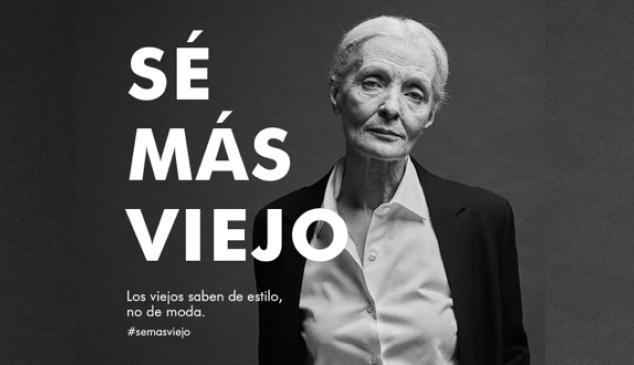
I was in my early 40s, vacationing in Malaga. I spotted her in a shop window from across the street – black and white, and 2D.  I crossed the street to take a closer look. She was the face of an ad of a Spanish clothing brand — silver hair, visible lines on her bare face, simple. I was riveted. Inspired. “THAT is how I’m going to age,” I thought.  

*

Let me give you some context.  

I grew up in the Philippines. The first time I thought about aging was when I was about 10. I was in church next to my mother, who was about 40 then. I glanced over at her hands and noticed how perfectly manicured they were. I looked at all the other praying hands of the women around me. All similarly perfect. I looked at my own nail-bitten hands and thought nervously, “I guess I’m going to have to work on my hands when I’m older.”

I was not a very girly child. While my best friend insisted on wearing her floral pink smock dresses and Raggedy Ann plastic high heels to play, I insisted on shorts. I didn’t dip into my mother’s jewelry and nail polish, and I thought that make up during ballet recitals made me look awful.

Even as I got older, I never cultivated my interest in effortful beautification. Before I’d step out of the house for a night with friends, my mother would nervously examine my face and beg, “Please wear more make up.”  I eventually left the Philippines before I learned how to do that.  By way of London and Hong Kong where I lived for a few years, I landed in New York where I lived for almost 20.  During those years, the Philippines developed a strong beauty culture, imbibing that of neighboring beauty meccas Korea and Japan.  My contemporaries honed the use of cosmetics and beauty treatments which kept them spectacularly fresh. Meanwhile, I took a different route. I focused on the inner work, as New York’s health and wellness culture liked to call it. I meditated, fasted and green juiced. I believed that with this lifestyle, I could slide into old age naturally and gracefully.

So — back to the Malaga shop window — here was this woman, somehow confirming that old age could be beautiful in its simplicity. That one can slide into it gracefully and elegantly without much effort.  She was the visual representation of how I wanted to age.  She got me excited about aging. 

*

Many years later, I happened to move to Spain. My excitement about aging deepened. The Spanish women seemed to embrace natural aging with much more ease than than the average. They have a more relaxed attitude towards their lines or other signs of aging. The Queen of Spain, for example, is often seen in photos with visible silver streaks.  I commented to a friend, “I love how Queen Letizia is so natural.  She’s not afraid to show her grays.”  My friend replied, “Pffff.  That’s just her slight nod to reality. She shows grays because she keeps the rest of her body impeccable.”

It then occurred to me that perhaps Spanish women can be relaxed about wrinkles because they are armed with so much provision — bountiful hair, golden skin, slender bodies, abundant sense of style, and a get-out-of-my-way confidence.  

It also occurred to me that I, too, could be excited about aging because I had my own ammunition: Asian genes. Giving no credit to anything but these genes, I was a 40ish year old who looked 30ish. 

It is easy to romanticize something you have no idea about. To think growing old can be exciting is to have no idea. 

*

A year later, I was diagnosed with cancer. They say every body reacts differently to treatment. My body’s reaction was to age overnight: instant medical menopause, weight loss, crepey skin, sunken cheeks, and dark spots from chemo-related acne.  I couldn’t bear to look at myself. Witnessing these changes was more difficult than any of the other side effects of chemo. 

I tried to anchor myself in the thought that these were mere physical changes; that I am so much more than this body. That I was also spirit and wisdom. That I was blessed to be alive for this experience. But I wasn’t buying any of it.  No amount of prayer or meditation could help me find peace with this transition. Because while I am more than this body, I also am this body. This body is how I interact with the physical world – how I meet it, and unfortunately but importantly, how I am met and seen. I wasn’t ready to be seen as older.

I decided I needed to start making an effort. I sought help from my Philippine beauty gurus, my sisters and friends, for tips on makeup and skin care. I went to the dermatologist. I watched countless youtube and instagram accounts of how older women were doing it. I embarked on my own elaborate skin care process, and (look Mom!), I finally started wearing more make up.

*

One day, I was at the airport waiting for a flight back to Spain. My hair was growing out from hair loss, and my gray streaks were prominent. My skin was on the mend. I was wearing big olive green glasses, and a denim-on-denim outfit.  I was walking from the shops towards my gate when I heard someone call out, “Excuse me!”

I looked around and saw a young lady, in her early 20s, making her way towards me from across the terminal. “Hi, I’m a representative of the UNHCR,” she started.  “I am supposed to be asking you for a donation, but,“ she paused sheepishly, “I saw you enter that store, and I waited for you to come out. I just wanted to tell you that I think you’re beautiful. I love your look.”

I was stunned. 

She went on giddily, “You remind me of Jamie Lee Curtis. Or the boss in The Devil Wears Prada. I love girl bosses.”  I was speechless. Jamie Lee Curtis and THE Meryl Streep, albeit magnificent women, were on average 2 decades older than I was. When I found my words, I thanked her, we hugged, and I walked away quickly.

I choked back tears. I tried to console myself with the thought that this young lady went out of her way to tell me something very sweet; that she saw beauty in this new body. But, in truth, I was inconsolable. She confirmed what I saw in myself: that I had become an older lady.  

*

The experience of the bona fide loss of youth, while it all transpires on the surface, is profound. What do we do with this sudden disconnect between how we feel and how we look? Where do we belong while we’re in this liminal space, reverse-metamorphosing from youth to elder? 

How do we avoid that pang when all of a sudden, and without our consent, the world baptizes us into a different category: when we’re told an outfit is “too young”; when they use usted or po to express seniority; when they call us Señora instead of Señorita (or Madame instead of Mademoiselle, or Tita instead of Ate). How do we ignore that in these tiny innocuous ways, they communicate the unraveling of our sexual attractiveness, our influence, and our relevance?

It is near impossible to slide gracefully and peacefully into aging. It is, more often than not, a tumultuous ride.  

The consolation is that aging is a shared story. The birthing pangs into eldership is a universal rite of passage. And the silver lining is modern women are learning to confront it as a community sport. Through art, movies, books, fashion, and social media, they are bravely and vulnerably taking up increasingly more space and wresting the narrative. To be excited about aging will perhaps always be a tall order, but the hope is that with a little more elbow room, women can more comfortably and confidently decide how to look and who to be in their next chapter.

An Ode to the Caregivers

By wingwmn · Follow: InstagramMarch 9, 2025

At 3am yesterday morning, I texted my still-awake sister from the ER, “What do we dooo?“ 

“Start thinking of how we’re going to tell the guests that the party is cancelled”. 

*
We had planned a birthday celebration for our Dad for 5pm that same afternoon.  But 14 hours before the first guest was to show up, my Dad was on his 7th hour in the ER undergoing a series of tests.  And my mom was 6 floors above on her 4th night of confinement, recovering from a medical procedure and infection.

*
Then,
At 5am, my dad was discharged from the ER.  
At 2pm, my mom was miraculously discharged. 
And at 10pm, when all the guests had gone home, we looked at each other in exhaustion and wonderment and sighed, “We did it.”

*
Such are the whiplash highs and lows of caregiving parents – a very special time:

*
It is a constant balancing act: between pulling the trigger on plans (because security deposits) but being open to flow (the list of last-minute plan-cancelations is long).  Between hope and managing expectations.  A balance between living your life but being available.  Between consulting them (with answers fluctuating daily) and making a decision taking everything into account.

*
It takes a village of every character: the planner, the execute-er, the introvert that takes care of the bills, the extrovert that takes care of the socials, the one who answers to “Dad left the house. Please find him”, the children who have children and entertaining stories, the early bird who is available for doctors’ early rounds, the night owl that tears the parent away from the TV at midnight, the detailed note-taker, the high-level cheerleader, not to mention the battery of technical caregivers who do the heavy lifting.  All shapes are necessary.

*
It is dotted with difficult moments: the sleeplessness, the worry, the last-minute decisions, the urgency of everything.  But there are also the “5am and 2pm moments”.  That, even when you say “we did it”, make you know full well the truth.  That it was Grace who did it, who swooped in to take over. So that we have breathing room to cherish this special time, and to remember that the village is so much bigger than what we see.

Adventures in a Foreign Tongue

By wingwmn · Follow: InstagramJanuary 29, 2025

They say learning a new language opens up new worlds.
They also say, “You’ve been in Spain for 3 years? You must be fluent!”

Wellll.

Sure, I have enough Spanish in me to walk out of a salon with the haircut I asked for. I also know enough Spanish to fix an earache. But the ability to say “Keep the volume on top, shorter at the nape” and “Everything sounds like I am under water” is barely new worlds opened. It just means I can do logistics in Spain.

*

My dream was to dominate Spanish – not just learn it casually like I did other languages, but really crush it. Own it. Understand its soul, inhale its words, twirl them around my fingers, debate with it, argue with it, and perhaps even write in it.

*

This desire stems not so much from the mere fact that I live here, but from the fact that the foundation of Spanish culture is the lexicon. If I lived in a less voluble country, say Japan, I doubt my linguistic aspirations would be as strong. But in Spain, discourse is the heart of the culture. Take for example, the tradition of ‘sobremesa’ where the Spanish hang around the table after a meal for extended periods of time to talk. Or the prolonged Spanish goodbye where bidding farewell just means that the conversation is transported in stages from dining table, to living room, to entrance way, to driveway, to car door. Or the fact that my partner uses his phone to actually TALK to family and friends.

On the streets, in the stores, at the dinner table — there are so many . . . words. Words flying in all directions: at each other, over each other, wrestling with each other. The golden tenet in conversation is: once you have the floor, never cede it. A Spanish teacher explained the expression “es que, o sea, te lo juro, de verdad [1]” as basically a bunch of words to fend off your interlocutor from speaking while you are thinking of what to say next. Hence, the other golden tenet in conversation is: remember that to shout is human, to interrupt divine.

The usage of words is a national sport. If I cannot participate, am I even here??

*

Let it be known that contrary to popular belief, the simple fact of taking up residency in Spain does not automatically make one a Spanish speaker. I say this particularly as an adult learner. Just because I sit next to teenagers gabbing in the bus doesn’t mean I come home linguistically wiser (I just come home with a headache.) Children, by contrast, pick up languages as quickly as they do viruses. Linguists agree that over the age of 10, learning a language needs focus and deliberation.

*

Armed with the trauma of formal language classes, I created my homespun version of language learning. The theme was Go Big or Go Home. I chose what I wanted to learn; I organized my own conversations; I joined reading clubs; I watched a lot of youtube videos.

I did a full and complete immersion — I set English aside and relied on Spanish for everything. If I wanted to read, I’d pick up a Spanish book. If I wanted to listen to a podcast, in Spanish. The news? In Spanish. A visit to a museum? Spanish audio guide. If I wanted to write, it had to be in Spanish (so I stopped writing altogether).

*

Of course, it is only when you lose something that you realize its importance. To me, it was the importance of precision. Language teachers advice: “You don’t have to understand everything. Just get the gist”. But to live in a state of gist is to live with a hangover: you are aware that something occurred but are not 100% sure of EXACTLY what occurred. One day, I stepped out of the elevator into the blinding lights of my lobby. I told the Spanish-only-speaking doorman, “Jose, qué luz! I feel like we’re in the middle of the sun!” He laughed and launched his rapid-fire explanation: “You remember last year, it was the same something-something . . . I tried to change the bulbs (laugh). . . the vice president of the building scolded me and told me that something-something (big laugh). . . need to keep them on until midnight but I’ll turn them off earlier (laugh). . . lots of girls come to take selfies something-something (laugh).” I understood what happened; I knew it was funny; but how funny? I’ll never know.

This insufficiency of gist works the other way, too. While visiting the city of Burgos, our friends insisted that we see the little church next to the cathedral. “You MUST see it,” they said, “we’ll wait here outside.” We entered the small, dark chapel. In the center was an inordinately large altar composed of intricate biblical scenes all etched out of limestone. It glowed under the only light streaming through the window. I was struck. We stepped outside. “Y??? Qué te parece [2],” they asked expectantly. The right words didn’t come — no “breathtaking”, no “unbelievable craftsmanship”, not even “spectacular”. I replied, “Superguay [3],” like any eloquent woman would.

The superguay altar of San Nicolás de Bari

Without precise words, the colors and textures of stories are lost. Nothing stands out; nothing sticks. My daily experiences were tepid shades of gray washing over me like teflon.

*

Fortunately, there was some pay off to all this. Little by little, I found flow – times when I was no longer conscious that I was Reading in Spanish, but simply Reading. Times that I was in a conversation to later realize it was entirely in Spanish. Times when I was listening to my partner tell a story and realize, not that he was speaking in Spanish, but that he is actually funny.

Then one night, while having dinner with friends, one of them pulled out her phone and showed us a meme on youtube. It was a video juxtaposing Spanish gypsies to the government of Spain. They all watched and laughed. I understood the words but not the humor. My friend thought about how to explain it, and with all the love (and pity) in the world said, “It’ll take a lifetime, and a walk through history, to explain what this means.”

I realized that this is where my linguistic plans fall apart. A nation’s esoteric expressions, humor, cultural innuendos are all born out of a shared past. To fully understand the commonly used “De perdidos, al rio [4]”, for example, one needs to talk about war. To grasp a Spanish mother’s threat “Te vas a enterar lo que vale un peine [5]” one needs to talk about the Middle Age torture.

In the same way, when I try to bring my own spin to the Spanish language, my attempts fall flat. I told my teacher “Tengo que encender un fuego bajo mi culo [6]”, and he nervously asked “What are you trying to tell me?”

Language comes laden with collective experiences. To define terms like “Pijo”, “Maria Clara”, and “White picket fence” to mean “posh”, “demure”, and “traditional suburban dreams” would barely be skimming the surface. Learning the language will not transplant the years of baggage that is attached to them. Besides, I’m half a lifetime too late for that.

*

Thankfully, Spanish has gone beyond being a practical language for me. Through it, I am now able to get a glimpse of the promised new lands by understanding a little more of its books, shows, dialogues. I may one day get a word in a conversation, argue, debate, even write. But I know I will never dominate it; never ever possess it.

Meanwhile, I have gone back to my own words, the words I grew up with. I’ve missed being able to read deeply, write details, and feel all the textures of my experiences. Through this meandering language journey, I have come to learn that while language can offer the excitement of new adventures, it also has the consolatory ability to bring us home.

*

[1] “because, I mean, I swear to you, really”
[2] “And??? What do you think?”
[3] “Super cool”
[4] Literally means “From lost to the river”; loosely means “What the heck?”
[5] Literally means “You will find out the value of a comb”, loosely means “Watch out”
[6] “I need to light a fire under my arse.”

**cover photo by Lucas Allmann. Doodle by me.

  • 1
  • 2
  • 3
  • …
  • 9
  • Next Posts »
© 2026
Design by SPYR