
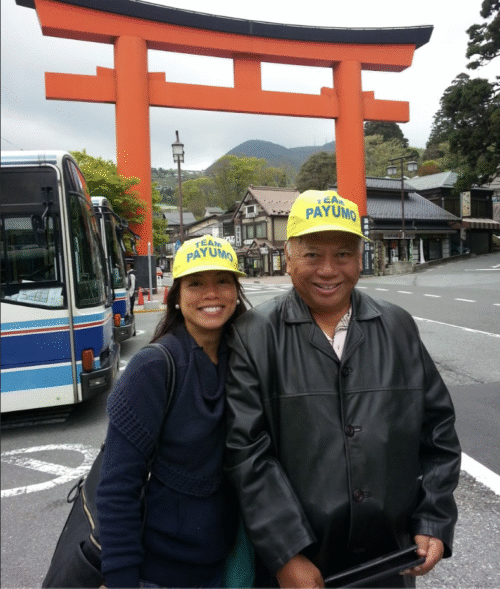
Good morning, everybody. I am Ani, child #2 and daughter #1 of Tong and Daisy.
On behalf of the family, I’d like to thank everybody for being with us today and through the week.
Your presence, messages, prayers, hugs — have meant the world to us.
__
A few years ago, I listened to an interview with a funeral director who was asked, “What makes a good funeral?” His answer: there are only four things needed —
there must be a dead person,
there must be mourners,
there must be a place to consign the dead — a hole or a niche, which we will see later — so the living can return to life itself.
And finally, there must be stories.
Not just facts like “Dad loved balut” or “He was always among the Top 10 Congressmen,” but stories that measure a life — stories that show how one person chose to use his time, and in turn, make us reflect on how we use ours.
This week, the stories flowed — in eulogies, posts, and conversations. Of course, we heard the heroic stories of how a precocious boy from Bataan became student council president at Ateneo, earned a scholarship to Harvard, and returned home first to be a businessman, and then to serve. We heard stories of how, as a Congressman, he authored laws that changed the country. We heard stories of how he transformed Subic for the 21st century, and later in life, created a university and a resort that celebrated nature. These were big awe-inspiring stories of achievement and vision.
But during the wakes, what especially moved me was seeing Mang Juanito, Dad’s former driver. He had made the long commute from Bicol to Bataan to be there and stand among the dignitaries that came to pay their respects. It moved me to see Dad’s staff, aides, secretaries, and household help — some from deep in his past — show up in full force, hug us and sob into our shoulders. There was something about Dad that elicited such devotion and loyalty; he was so loved.
And I know that this “something” is not found in the big, sweeping stories of achievement. These invoke admiration and respect, and as a daughter, profound pride. But these stories are not necessarily the stuff that cultivate such fidelity. What stirs the soul and inspires the tears are the smaller stories that we heard.
Let me share some of them – of others and my own.
__
Dad had a faulty memory in his later years. When I’d ask him what he had for lunch, he’d pause and say, “I guess it’s not worth remembering”. But what he did remember, he remembered. He could rattle off the names of every teacher he had from first grade, including the American Jesuits who tried to get rid of his Bataan accent (“say ‘baaaaad,’ not ‘bud’. ‘Saaaaad,’ not ‘sud’”.) .
A few years ago, a small elderly woman came to the resort. I watched Dad look at her, cock his head, and ask “Ms Diaz??” She said, “Tong??” Dad looked at me – “My first grade teacher!” She responded, “My smartest student!”. He remembered her after eighty years . (Ms Diaz was at his wake on Monday).
He also remembered when people needed help. Kaye, his goddaughter, told me “When I was having a hard time raising 4 children as a single mother, I never asked him directly for money. But he knew I needed help, so what he did was he visited the restaurant all the time, brought friends there, and held meetings there.”
Dad also never forgot who helped him. He always told us: a debt of gratitude is never ever repaid. If someone lends you 100 pesos, your debt is not repaid when you pay him back the 100. Your debt continues ad infinitum. And this, he lived by. While his tuition in Harvard was covered by a scholarship, he relied on his older brother, Tito Pito, for rent and food. Tito Pito would send proceeds from the family’s rice harvest. Decades later, Tito Pito, as Mayor of his town was killed by political rivals. Without a second thought, Dad upturned his comfortable life in the private sector and ran for Congress in Tito Pito’s honor. This appreciation flowed on to the next generation. He took care of Tito Pito’s children as his own.
There were stories from his team in Congress and SBMA, those who worked with him, of Dad working them haaaard. They worked long hours, often from 5am to 11pm, hiked up and down mountains for ocular inspections, being eaten alive by mosquitos and flying leeches. But while Dad worked them hard, he was in the trenches with them. And because of this, because of his wisdom and kindness as a leader, and because they knew they were working for something bigger than them, they were happy to work hard with him.
Dad always made it a point to stay in touch with people. When Tonito was out of the country for 2 weeks, Dad would call Tonito’s kids every day. The conversation would be the exact same one from day to day. After a few days, my sister and I were able to recite it together with him; “Hi Soph, how are you na hija? Whatcha doing? . . . Did you talk to your dad today? . . . What grade are you in na? . . .. Okay hija.”. He’d hang up, and say “See? How hard is a 3-minute check in?”
Whenever he’d visit Bataan even long after his political stint, he made unannounced visits to friends, former staff, and aides. These visits could last anywhere between 3 minutes to 3 hours, shooting the breeze, catching up on local politics, and eating.
__
There was nothing he liked better than telling stories over food. Dad was amusing company. He was joyful, light, and to Moms’ frustration, sometimes somewhat embarrassing. At the resort, if we couldn’t find him, we knew exactly where he was — sitting by the bonfire with the guests, telling stories, and eating their food. Mom would send someone to apologize and to extract him from the scene, but it was the guests who insisted he stay.
Recently, at a wake, Jane, his caregiver said – while in conversation with someone, he picked up a balut without thinking of the mess it would create. No plate, no napkin, he cracked the egg open. He slurped; juices dribbled down his chin and shirt; he kept in his hand the shell and the bone. Mom, again out of embarrassment, sent Jane to clean him up.
To mom’s frustration, Dad couldn’t have cared less about etiquette and protocol. We joke that she could kiss her dream of being a diplomat’s wife goodbye; her husband was not diplomat material — he eats before his hosts, he didn’t care about what he wore. We would get panic texts from Tonito, “Dad is in this Harvard event. He’s in shorts and hiking boots. Can someone pick him up and change him??” My cousin would say “Whenever Tito Tong comes over, we tell the cleaner that she was off-duty for the day. Tito Tong will clean the floor with his pants.”
He loved holding hands. He held our hands all the time. In fact, one time on the way back from Bataan, my partner, Javier, sat next to Dad in the van. Next thing he knew, Dad, asleep, reached over to hold his hand. Javier, the good man that he is, let him. They sat there, hand in hand until Dad woke up.
__
These are just a few of the little stories we tell each other when we remember him. These are the stories that make us laugh, cry, miss him.
The way he was so naughty.
The way he was wise.
The way he was always present in our lives.
The way he was funny without trying to be.
The way he was kind and caring.
The way he was sometimes embarrassing.
These stories are not the stories that land in history books to be passed on through the generations. Rather, they are told on the sidelines and tend to fade with time. But they are worth telling because they paint the full picture of who Dad was. And, for now, they are lodged in the hearts of those who had the great fortune of knowing Dad.
When we, his family and friends, return to life itself and reflect on how to live out the rest of it, we may get caught up in the larger story of our achievements. But let’s not forget that it was in the smaller stories where Dad touched hearts, and where we might, too.
Dad, thank you for sharing your life with us. We were so lucky.
And Dad, I am telling you now that I will not fill your shoes. I would need 3 lifetimes to do so.
But, I will write my own story in honor of your great, great one.
Thank you.