wingwmn

spreading my wings and sharing random lessons learned along the way

  • About
  • Life
    • Life
  • Curiosities
    • Design
    • Travel
  • Articles
  • Subscribe

Journal Series #3: Creative Imagination

By wingwmn · Follow: InstagramAugust 29, 2017

In my efforts to drastically downsize, I’m ‘digitalizing’ my journals. That’s millennial speak for “rereading 15 years worth of notebooks and manually typing notes and highlights into my laptop”. Here, I share some of the notes – to digest the arc that is my life, to share a giggle, and most importantly, to satisfy my sister’s general inclination to snoop after I’ve thrown the physical journals away.

August 2002
(Fifteen years ago to the month.  First week in New York as a student)

“You’ll never know. When you go to the bathroom in the middle of the night, he may be in the hallway waiting to pounce. Buy a portable toilet for your bedroom. Charge it to my account.”

– Mom, when she learned I had a boy as a flatmate

Creativity and imagination runs in my blood.  I am confident of, and comforted by, that thought.

The Psychology of Purging

By wingwmn · Follow: InstagramAugust 25, 2017

I am having a slight issue with things. Getting rid of some of them, to be more specific. When I first started purging, I tossed and flung stuff away like it was nobody’s business. I donated 80% of my wardrobe, and boiled my stuff down to things I liked.  I was a vocal advocate for cleaning out. It was easy and liberating, I pontificated. Like skimming off unwanted fat.

But now, I’m scraping bone. And it hurts.

So apparently, there is this deep relationship between our possessions and ourselves. Part of being human is the ability to contemplate our identities – who we are, how we fit in, what makes us unique. We individuate ourselves through our provenance and our religion, and also through our relationships, our interests, our qualities, our social status. Having a sense of place in the world underpins our self-esteem and happiness.

Our belongings play an important role in the formation and reinforcement of these self-concepts. They are the tangible embodiment of our identity, defining and reminding ourselves and others of who we are. As adolescents finding our voice, for example, we placed so much emphasis on what we owned. The clothes we wore, the music we listened to, the stuff we carried signaled who we were to our peers. This does not change in adulthood. Our bookshelves, our wardrobes, our cars, our homes — they are the curated stories we want to tell: I am successful. I am an artist. I am a successful artist. I am a loving mother. I am an intellectual world-traveler. “I, a (fill-in-the-blank) individual, am here”.

Purging and Our Fluctuating Identities

Since our possessions are vessels of our selfness, purging can feel extremely liberating. When we go through identity upheavals — end of relationships, change in status, etc. — purging can symbolically (and maybe literally) shed a part of us that no longer serves. We then give ourselves the space to evolve into someone else.

In a limited way, once I threw out my martial arts trophies, my relationship with martial arts shifted from that of stress and needing-to-compete to that of the pure joy of practice. On a larger scale, it was no coincidence that my urge to do a deep purge coincided with my thoughts of changing career. I slowly started letting go of my corporate clothes, my high heels. The act of doing so manifested the internal change that was occurring, and at the same time, boosted my courage to finally effect the change.

In the same way, when we lose possessions that we consider materializations of our current selves, we feel gutted. Like when we are robbed, we feel violated — as if there was an actual intrusion into our deepest selves.

Right now, I am having difficulty letting go of a certain smattering of things that on the surface may seem ridiculous — my martial arts gear, a few pieces of art and pottery, a handful of letters from friends and family. To me, they embody my current “selfhood”: a martial artist, a budding (hopefully) creative, a decent friend and sister. To throw them away would be to pull the rug from under me. Too destabilizing. So for now, I keep.

Purging in the Age of Technology

Luckily, we no longer have to rely heavily on material objects to assert our identity. Technology has helped loosen this dependence. By giving us an alternative way to define and express ourselves, the minimalist lifestyle has become an entirely doable concept. Why buy Egyptian souvenirs when we can post photos in front of the pyramids? Why buy beautiful stuff when we can represent our aesthetics on Pinterest? Why purchase books when we can download them on an iPad and follow authors on Twitter? Why keep mementos of our relationships when we can honor the people (and share memories) on Facebook?

It’s not my place here to talk about the inflation or extreme curation of our online identities. My point is simply: to reveal who we are, we now have more options  available to us than previous generations. And if I may unabashedly admit, this is perhaps why I write on this blog — to honor and give voice to this current, temporary, yet very pivotal version of myself. Instead of accruing trinkets for my hypothetical grandchildren, I write as markings on the wall that this fearful, extremely uncertain, yet absolutely certain self was here.

Sweet Little Manifestations

By wingwmn · Follow: InstagramAugust 7, 2017

Warning: we’re going a little hippie-dippie-new-agey again today.

I’ve never been a vision board type of person. I never understood how an afternoon spent cutting out photos from magazines could change my life. And so it followed that I also never got into the Law of Attraction, nor did I ever feel the celebrated impact of daily affirmations or visualizations. They just didn’t feel very instinctive to me. It seemed almost humanly impossible to maintain “only positive thoughts”. What, then, do I do with all my fears and doubts??? . . . I don’t know. All of it felt too ‘optimistic’. I figured that if I wanted something out of life, I could get it with a little bit of prayer, a little bit of luck, and a whole lot of hard work.

Then a couple of years ago, I stumbled upon Lacy Phillips. I liked her nuanced views on manifestation and was curious enough to attend a couple of workshops while she was in NY. Her approach to manifesting desires is simple and a lot more intuitive to me. No vision boards and mantras necessary.

Manifestation Principles

The core principles of her approach to manifestation are these:

Clarity. We need to be very clear about what it is we are manifesting or calling into our lives. She recommends we write it down and be very specific. If we are vague about what it is we are trying to attract, the universe will send us vagueness. To use Lacy’s example, we shouldn’t say, I want to change jobs but I’m not really sure what it is I want to do next. We need to get clear first.

A couple of related points: One, since we are required to be very clear about what it is we are manifesting, it is recommended that we manifest for a short-term horizon (about 6 months max). Anything beyond that becomes vague since we are constantly evolving. Two and very important, what we are manifesting has to come from our core desires. Not from our ego. Not because anybody else but ourselves is telling us we should want it. Thus, if we are trying to manifest a partner, subconsciously so that we can make our ex feel bad, we can manifest this partner until the cows come home to no avail.

Believe. It is key to truly believe that the subject we are manifesting is arriving. This is not so easy to do, and hence is a core part of Lacy’s work. We all have a ton of insecurities and fears that have developed from our childhood and from society’s programming. These insecurities form subconscious limiting beliefs that make us doubt our ability to get what we want. I want a career change (but I’m too old). I want a partner (but I’m overweight). It is essential to rid ourselves of these blocks — through the use of logic, theta healing, hypnosis or whatever it takes to do so.

Trust. Once we’ve done the work of getting clear and removing the blocks, then we must trust that what we’ve manifested is on its way. This is where taking risks and jumping off cliffs makes us very magnetic. When we jump off cliffs, we are telling the universe that we are trusting it fully.

An important aspect of trust is believing that what we are calling is being delivered in its full form. Thus, we should never settle for half-baked things that come into our lives. These are tests to see if we fully believe we can have everything we ask for. If we settle, we are telling the universe we don’t trust that we can fully have what we want.

I encourage you to dig around her site. It’s rich with detail.

Sweet Little Experiments

To be honest, I haven’t tried manifesting around weighty matters like career and love. Partly because see Clarity above, and partly because a little part of me wants to leave these things to fate. Or faith. But for shits and giggles, I’ve tried manifesting little things, and have come back with amusing stories.

Here are a couple of recent Sweet Littles:

London Apartment.  I’ve signed up for a short intense course in London in the Fall. The classes start promptly and painfully at 8am. It was, thus, very clear to me that I would need to find an apartment close to the school. Several family members and friends very generously offered up their place, but they all live in West London which is at least an hour away from the school.

So, I threw up a request to the universe for a suitable apartment. I didn’t yet know how I was going to find it. But when I visited a friend who had recently moved from the Upper West Side to a flatshare in Brooklyn, she told me that she found the place through a site called spareroom. Not knowing that I was searching for a London flat, she mentioned that the site actually started in the UK. Hmmmmm.

So, I checked out the site that night, and placed an ad that listed out what I was looking for: a quiet, peaceful apartment for a Monday to Friday rental (as I will stay with my sister during the weekends); within walking distance from the school; with a private bathroom; at a (more or less) specific budget.

I received numerous offers — from groups of girls (too sorority party), couples (too awkward), homeowners with beautiful homes and gardens (too far), people who wanted to play tennis during the weekends (too best friends-y), professionals (too shared bathroom-y). Then I received an email from a chap, “I appreciate my apartment is across the river from your school, but it would be a great walk. You or your sister might want to view it”. When I was in London 2 weeks ago, I went to check out the apartment and meet the fellow. The apartment meets all my requirements plus plus (washer/dryer, etc.), is in a lively location along the river and just across the river from the school (which makes for a nice short walk over Tower Bridge (in photo)), and has tons of restaurants and bars around. Chap and I got along swimmingly, AND since he works outside of London, will only be in the apartment on weekends! Ummm helloooo. Check, check, check, check, and double check!

New York Furniture.  Since I am getting rid of most everything I own, I put an order to the universe for a painless process of disposing of my furniture. I was prepared to do one or a blend of the following — sell stuff on Craigslist, leave stuff on the sidewalk (which would necessitate hiring guys to disassemble the furniture and carry them downstairs), and hire a demolition team to take some furniture and put in junk (which, apparently, is also quite expensive).

While I was in London, I received an email from my building’s management saying “We have new tenants for your apartment. They would like to move in pretty much as it is. Are you willing to sell your furniture (down to the art)?” Ummm hell to the yeah!

To the universe, to little experiments, to Lacy, I am grateful.


Have thoughts on manifestation?  Let me know in the comments section below.  

The Art of the Chat: An Ode to New York

By wingwmn · Follow: InstagramJuly 30, 2017

Vienna, Austria.  I’m craving a good conversation, and I’ve got New York on my mind. The Viennese, I’ve come to realize, don’t do chats. Viennese conversations with strangers, while perfectly polite, are purely transactional. Ask one question, you get one answer.  (In fact, Viennese conversations with foreign-looking strangers don’t even reach the transactional level.  A woman at the grocery store ran away from me today.  But that’s another story. . .)

New York chats, on the other hand, are anything but aseptic. Ready or not, New Yorkers will weave their personal lives into the most impersonal of topics. Do what you wish out of this unrestrained (often TMI) openness. A recent overheard conversation captures it all:

Waitress: It’s better to drink tepid water.
Customer: What’s tepid?
Waitress: Lukewarm, like i how I feel about my husband.

Ah, New York. So special. 🙂 New Yorkers are open books with anybody willing to listen. Accustomed to being ‘polite’ and respectful of other people’s personal space, most outsiders would cringe at this overexposure. In most parts of the world, the norm for ‘proper’ conversation, particularly with strangers, remains within the boundaries of the “safe topics” — the weather, where we went, what we did. Consequently, interactions are sterile and forgettable. I would add that when dialogue is limited to how great things are going and what achievements we’ve accomplished, the result is boredom. Alain de Botton, in his School of Life series, says that for meaningful conversations to occur, one should have the courage to go beyond the facts, and venture into the uncomfortable territory of feelings, vulnerabilities and failures.

Maybe it’s the small living spaces that force New Yorkers to make a living room (or therapist office) out of the entire city, or maybe it’s a certain loneliness that makes us seek connections. But New Yorkers frequently and willingly dive headfirst into this uncomfortable territory de Botton speaks of.  A woman in my morning commute asked for a tylenol and regaled me with stories of the ex-boyfriend she had met up with the previous night; another woman crossed a crowded subway car to ask for my stylist’s contact details and told me about the fight she had with hers; the cashier at the grocery store recounted the emergency call she got from her son’s school about her son’s antics.

Of course, this rawness does not always lead to pleasant encounters (such as getting kicked out of cabs, or unwanted advances). But if we do not instantly reject these encounters, and instead, remain open to them and what they can offer, this lack of censorship can forge profound connections, even for a tiny moment. Contrary to what we’ve been taught about “polite conversations”, de Botton proffers that people actually appreciate being shown others’ failures and vulnerabilities. This has less to do about wanting to see others fail, and more about wanting to know that we are not alone in our struggles. Knowing “that our own sorrows have echoes in the lives of others” is what connects us.

After a particularly difficult breakup, I took a lunch breather at one of the benches in Rockefeller. A middle-aged man in shorts and sneakers, with elegant salt and pepper hair, sat next to me. After some silence, he casually mentioned he used to work in the area but quit the law profession to try his hand at entrepreneurship. We got to conversing; I prodded a little more about his life. He mentioned his wife had divorced him.  He went through a tough period, he recalled, but is in a much much better place. He then said, “Look it all boils down to this: we all just have to relax. Life has a way of working out.”

If we find the courage to bring our conversations to new depths, we may be pleasantly surprised.  Even in a large, impersonal city such as New York, we are offered countless opportunities to discover that at the other end of the dialogue is a person with the same struggles as we do — of finding an apartment, of finding love, of finding solace, of making it here. Through these meaningful conversations readily available at any corner grocery or park bench, the city becomes our surrogate family. It consoles us, uplifts us, encourages us, makes us feel less alone, and effectively makes itself enormously difficult to leave.


I would love love love to hear your thoughts.  Drop me a line in the comment section below. 

The Journal Series #2: Boots

By wingwmn · Follow: InstagramJuly 17, 2017

In my efforts to drastically downsize, I’m ‘digitalizing’ my journals. That’s millennial speak for “rereading 15 years worth of notebooks and manually typing notes and highlights into my laptop”.  Here, I share some of the notes – to digest the arc that is my life, to share a giggle, and most importantly, to satisfy my sister’s general inclination to snoop after I’ve thrown the physical journals away.

Score!! Found some Daisy-isms.

Undated

“Ani, please promise me that if you meet Mr. Right, you’ll pretend to be sweet, gentle and helpless.  No one likes to seduce a boot.”

Did she just call me a boot???  Nothing like mothers to keep you grounded, no pun intended.

The Journal Series #1: Bullet Points

By wingwmn · Follow: InstagramJuly 15, 2017

In my efforts to drastically downsize, I’m ‘digitalizing’ my journals. That’s millennial speak for “rereading 15 years worth of notebooks and manually typing notes and highlights into my laptop”.  Here, I share some of the notes – to digest the arc that is my life, to share a giggle, and most importantly, to satisfy my sister’s general inclination to snoop after I’ve thrown the physical journals away.

Excerpts

2011:

– March – Fly to Puerto Vallarta to look at wedding venues.
– June – Stop wedding planning. Forfeit deposit.

2012:

– Feb – Break up. Again. Final.
– April – Move out.

If I could time-travel back to August 2011 and sit myself down in front of this couple, this is the tough love I would give:

“What is this madness?  You called off a wedding. So tell me, what are you doing still together?  You both know with every fiber of your being where this is headed.  You know in your gut where you want to be.  So what’s happening?  I know, I know. . .

You’re worrying about each other — about hurting each other. Stop.  Please, you aren’t the messiah.  Disabuse yourself of the idea that the other will wilt away without you.  You fell in love with someone strong and resilient.  They’ll be okay.  They’ll probably be even better without you.

You’re worrying about what other people will say.  Stop.  You’ll be gossip fodder for 2 minutes, then they’ll move on.  Besides, this is YOUR life.  Tell them to go get their friggin’ own.

You’re worrying about logistics — about the hassle of looking for another apartment.  Of dividing up your stuff.  Stop.  That is NO REASON to stay.  Hire movers.  I swear, these guys will take all of 2 hours to pack up your life and move you out.

You’re worrying about ever finding anybody else.  — You may find somebody.  Or you may not.  But either outcome should be better than this tortured space you’re in now.  So stop, stop, stop.

Do what you need to do.  Live your truth.  There might be some pain, but I promise you, soon enough, this episode is quite literally going to be just a set of bullet points in your story.”

On Stuff and Stoics

By wingwmn · Follow: InstagramJuly 10, 2017

I am sitting in the middle of my apartment among boxes of things packed away for donation. I am giving away most of my possessions; pointless to own anything as a semi-vagabond. My goal is to fit everything I own into two suitcases all weighing less than 100 pounds (not arbitrary; airline baggage rules).

The process of giving away stuff doesn’t bother me as much as it might have in the past. My relationship with material things shifted massively about 4 years ago. Influenced by the likes of The Minimalists and Mari Kondo, I whittled down my possessions to a fraction of what I owned, saving only the things that “brought me joy”. Joyfully, I coasted along under that guiding concept until one day, I learned that my beloved fragrance I had been using for 10 years was discontinued! The horror! That totally shook me. To the core. (This may seem overdramatic, but most of you will understand the struggle of finding that perfect personal scent. Right??)

Thankfully, I survived that event. And I promised that I wouldn’t allow myself to become dependent on anything material again, especially the things I loved. So now, when I find myself relying heavily on any one thing (a product, a brand, a diet) that could be taken away from me or that I have no control over, I loosen the dependence by giving it up for a while (or forever). This is how I gave up make-up, why I spend periods of time away from martial arts, and why I quit veganism.

ENTER THE STOICS

Granted, I have my quirks. But this unusual behavior is not entirely alien. It is rooted in Stoicism, an ancient Greco-Roman philosophy that was born over 2000 years ago. I first heard about Stoicism in 2005 when I read Alain de Botton’s The Consolations of Philosophy. I was later re-introduced to it by some of my favorite authors/speakers, Tim Ferris and Derek Sivers, who also practice this unusual technique. Founded by Zeno and popularized by prominent thinkers, Marcus Aurelius, Epictetus and Seneca, Stoicism has seen revivals through the ages, particularly during the Renaissance and again in modern times. Many leaders, artists, entrepreneurs practice Stoicism as a way of life.

As a practical philosophy, Stoicism is a set of teachings that help us gain a mastery of ourselves and our emotions. Most of us are helpless victims of our mood swings. We all know it — our moods can be altered in a flash by a single conversation, by traffic, an unanswered text, or shocking news. We have ceded our happiness, it seems, to Fate’s mercy.

One of the central pillars of Stoicism is the use of reason to temper these fickle emotions. Stoics teach that a key to mastering our emotions is to differentiate between the elements we can control and those we can’t, and not to sweat the things that we cannot do anything about. Thus, if Fate deals us an unpleasant hand — be it a discontinued fragrance or a loss of all our wealth — our inner peace is intact.

Expect Everything.  A practice to master this, according to the Stoics, is to expect unpleasant events to happen. Seneca encourages a daily premeditation which begins:

“The wise will start each day with the thought…
Fortune gives us nothing which we can rely on.
Nothing, whether public or private, is stable; the destinies of men, no less than those of cities, are in a whirl . . .”

We need only to look at natural calamities, accidents, shocking events that happen on a daily basis to understand the randomness of Fate. Fate doesn’t distinguish between the wealthy and the poor, the physically strong and the feeble. No matter how big a fortress we build, we are never immune to loss and pain. Hence,

“Never did I trust Fortune, even when she seemed to be offering peace. All those blessings which she kindly bestowed on me — money, public office, influence — I relegated to a place from which she could take them back without disturbing me. Between them and me, I have kept a wide gap, and so she has merely taken them, not torn them away from me.” – Seneca

Practice Discomfort.  Another practical technique advocated by the Stoics is voluntary discomfort. Stoics did not shun a pleasurable life. However, they encouraged a regular practice of poverty and discomfort to temper our dependence on material luxuries, to strengthen ourselves against future misfortune, and to reduce our fear of it.

“Set aside a certain number of days, during which you shall be content with the scantiest and cheapest fare, with coarse and rough dress, saying to yourself the while: “Is this the condition that I feared?” – Seneca

Modern day Stoics practice this in various ways. Tim Ferris eats only rice and beans for a few days at a time to practice hunger. Or intentionally wears ugly shoes to practice the discomfort of ridicule. Others sleep on the floor, use cold showers, go without phone or internet, (stop wearing make up, abstain from martial arts, ahem ahem). . . the options are endless. The goal is to strengthen ourselves and remain unperturbed by the shifting external conditions we find ourselves in.

BACK TO THE FUTURE

So, as I sit here among boxes contemplating what lies ahead, I am unnerved by the thought that I will soon possess almost nothing — not a plate to my name and no home address to speak of. For a period, I will be moving from place to place, living under the roofs of generous souls (my sister, my parents, friends, airbnb hosts).

This all feels profoundly antithetical to what we naturally strive for. We spend our lives working hard to build a bastion of safety and comfort, a home where we can feel safe to let our guards down and be our truest selves. I’ve worked for the same things, and I’ve been fortunate to have been able to do so. On a visit to NY, my Mom commented, “Now I see why you’re single. Your life is so comfortable. There is no point ruffling it up.”

That comment gave me pause (not the “single” part. I’ve become immune to that). Sure, it is nice to have a cushy life, but have I become too rigid to withstand any bit of ruffling? Have I become inflexible? And have I become too dependent on this single-girl NY lifestyle for my happiness? The Stoics remind us that life is shifty. This fun, independent lifestyle I’ve built in NY will be ruffled up whether I like it or not. Rents will skyrocket; friends will marry and move to the suburbs; Trump may ruin everything; and even I may get married.  And then what?  What will become of me when things are shaken?

And this is why I feel it is necessary to leave home, this home, even temporarily — to loosen my dependence on NY (or any one place) for my happiness. Yes, it is a grand and strange exercise in Stoicism. But I hope to come out of it with the learned wisdom that the happiness and peace one derives from ‘home’ has nothing to do with the physical structure or city one finds herself in.


How do you deal with dependency?  What are your views on Stoicism?  And Stuff?  I would love to hear your thoughts.  Let me know in the comments section below.

The Creative Struggle

By wingwmn · Follow: InstagramJuly 1, 2017

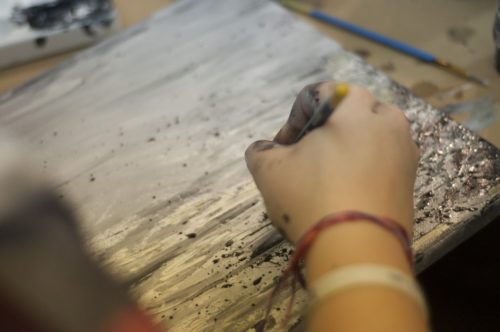
Today, I spent three hours in the bookstore reading about painting. To most, this might seem like a productive way to spend the afternoon. I, however, was sorely disappointed at myself for having succeeded yet again at procrastination. You see, I had planned to start my creative journey the day I left my job. It’s been over 2 months hence, and I have nothing to show for. I have not picked up a brush to paint. I have not lifted a pencil to draw. And I have not logged on to start my coding course. Instead, I’ve used every delaying tactic in the book. I’ve even opted to organize my closet, file my amended tax returns, AND organize my photo library to put off having to draw!

I know I’m not alone here. I’ve had more than a handful of recent conversations with people facing the same battle — they have creative projects they long to do but are struggling to even begin. One wants to start song-writing but is waiting for inspiration to strike; another wants to sell hats (and has a store lined up to offer them) but is questioning her ability to meet the store’s standards; yet another wants to produce a documentary about his family history but doesn’t know where to begin; another wants to start a business but is nervous about the reception of her product; and still another wants to dance but worries she’ll be ridiculed. The list is long. The struggle to begin the creative path is real.

Elizabeth Gilbert says that all these different forms of paralysis all boil down to the same thing: fear. If I may distill it down further based on my conversations and my own experience, it is a fear of not succeeding, a fear of realizing that I may not be good at this thing I want so badly to do. For me, this fear has been so overwhelming that it has kept me from drawing a single line on the sketch pad I carried during my travels because I was afraid that the drawings may not be pretty!

This fear, Gilbert goes on to say, parades itself in fancy shoes as ‘perfectionism’. “Perfectionism . . . often stops people from beginning their work. Perfectionists often decide in advance that the end product is never going to be satisfactory, so they don’t even bother trying to be creative in the first place.”

To give up on a project before it even starts, to allow the spark of inspiration to fade inside of us, would be a monumental pity. So, I’m writing this (procrastinating much?) as a gentle nudge for myself and my friends who stand at the threshold of creating, still hesitating in fear:

Fear is our Compass

Let’s give fear its proper place in this struggle. Fear isn’t all bad. In fact, it is an important component in our creative growth. Fear is the compass which points out where we should be headed. Steven Pressfield in the War of Art says, “The more fear we feel about a specific enterprise, the more certain we can be that that enterprise is important to us and to the growth of our soul.” Think about it. The more we want a particular job, the more fear we would feel during the interview process. The more feelings we have towards someone, the more fear we would have in approaching him. If something didn’t really matter to us, we wouldn’t really care so deeply.

So, to walk away from something that is meaningful to us would be, first and foremost, harming ourselves. We would be robbing ourselves of the opportunity for growth. The creative seeds should be given the opportunity to bloom; to choose otherwise would be to mute ourselves.

It may be helpful to remember that fear does not discriminate. Every accomplished artist still faces fear. Pressfield assures us, “there is no dread-free artist.” The difference is that a true artist doesn’t allow fear to stop him. He forges on with his work.

Create Non-Epic Shit

As amateurs struggling to even begin, let’s ditch the idea that we must create epic shit. Who needs that additional pressure in our lives? We don’t need to be the next Uber, the next Lin Manuel Miranda, or the next JK Rowling. Heck, we don’t even need to be good! Our job right now is simply to explore this idea we have. To follow a curiosity. And to understand if this itch we are scratching is, indeed, something we want to be pursuing for the long-haul. That is all.

Allow me to draw on my limited blogging experience. For the first 5 months of its existence, I told NO ONE about this blog. I wrote for myself; to download and process thoughts that were wrestling to be released. I knew nobody was reading. I wasn’t able to validate if anything I was writing was resonating with anyone. But each time I published a post, I felt the relief and joy that would presumably come with coughing up a little gremlin growing in my throat. And for me, that was enough.

For those who want to do creative work that is necessarily commercial (like starting a business), accept at this point that we are not going to please everyone. So, trust your taste and make what pleases you. Don’t worry about what will sell. Your role now is to create. Focus on that.

It is advised that we shouldn’t be a creator and a critic at the same time. To be both is to tap into 2 different parts of the brain, and that pulls you out of your flow and makes the creative process much slower and much more arduous. So avoid immediately editing every sentence you write or judging every footage you film. Just keep creating. Let the designers, editors, and producers (all of which may also be you) worry about the commercial side later on.

No One is Judging, So Play

When my parents had parties at home, my mom would ask us to play the piano. Mind you, this wasn’t the type of parent showcasing where guests were forced to sit and listen to a 7-year old play Chopsticks. It was a lot less daunting than that. My mom simply wanted us to play while guests were going about their partying. And yet, I was too mortified to do so. Until, at one particular party, she said the magic words, “No one is judging you.” I looked around and noticed that, in fact, the grown-ups were busy chatting, drinking and eating to care about what I banged out on the piano. That knowledge gave me the boldness to play and play badly.

The same applies to our art. As amateurs, no one is really watching. There are barely any expectations for us to meet. The bar for us is so deliciously low. Why not take advantage of this, and give ourselves the license to explore, play, and make grand mistakes?

Just Begin

Sure, our creative endeavors may seem daunting. But taking our focus away from the immensity of the project, and concentrating on simply taking each next step helps transform the journey into a manageable one. Let us finally show up, and allow the experience to take us where it may. It might bring us to some sobering and enlightened realizations that the pleasure creating brings isn’t worth the pain. Or, it may lead to magic. We won’t know unless we begin.

“Concerning all acts of initiative (and creation), there is one elementary truth that ignorance of which kills countless ideas and splendid plans: that the moment one definitely commits oneself, then Providence moves too. All sorts of things occur to help one that would never otherwise have occurred. A whole stream of events issues from the decision, raising in one’s favor all manner of unforeseen incidents and meetings and material assistance, which no man could have dreamed would have come his way. Whatever you can do, or dream you can do, begin it. Boldness has genius, power, and magic in it. Begin it now.” – Goethe


Are you facing the same struggle? Have you fought through the fear? Would love to hear your thoughts. Let me know in the comments section below.

My Spiritual Pilgrimage

By wingwmn · Follow: InstagramJune 16, 2017

Warning: we’re going a little woo woo hippy dippy today.

My parents invited me to join them on a 12-day pilgrimage around the UK and Ireland last month. I jumped at the chance thinking it would be a nice way to spend time with them. I had not focused on the fact that pilgrimages generally have a spiritual component to them.

Needless to say, I was not prepared for what was in store. I recited more prayers in one morning than I had in the past 5 years combined. While it was a joy to be with a group of generous and loving people led by Fr Jerry Orbos, I felt like a fish out of water. The religious practices were unfamiliar and strange to me now.

I found solace, however, in what Fr Jerry said at the very start of the retreat, “Pray with words if you wish. Or just pray with your heart. Each one of us has our own relationship with the Lord.”

My faith was largely formed in an ultra-conservative all-girls Catholic school. For 11 years, we were prescribed formulas on how to “know God”. We were forced to memorize a manual of Catholic principles, made to recite a litany of prayers at appointed times, pulled out of class each week to reflect on our sinfulness and confess our sins. We were lectured on how to dress appropriately so as not to tempt our fathers and brothers (?!!), herded into buses for mini-pilgrimages, taught how to properly genuflect in front of the altar. Not to mention the basic rules of attending mass on Sundays and holidays, fasting and abstaining on appointed days, getting ashed on Ash Wednesday, fasting at least an hour before communion, etc etc. As a type A student, religion became a mental exercise: follow the rules and your soul will be saved.

My relationship with God was that of a strict distant father high up in gold-gilded Heaven to whom I called out when I needed a favor. He, meanwhile, was playing and replaying videos of my life, tallying points based on my adherence to his rules. My relationship with humans was largely the same. I judged people based on their outward religious acts, and they, too, judged me (a priest once told me to be thankful I didn’t get hit by a bus before I was able to confess my sins).

I was a brooding child, bereft of lightness, joy or spontaneity. I grew up guilty about everything and fearful of everlasting repercussions (I regularly woke up in the middle of the night anxious about the thought of eternal damnation). Ironically, religion became the oppressor that kept me distanced from God.

I do wonder what would have become of me had I not attended a university run by the Jesuits (the order that the fabulous Pope Francis is from). The Jesuits are known to be the Catholic liberal thinkers. They are more inclusive and more in touch with the world, the “socialists”. Just a few years with the Jesuits chipped away the tyrannical constructs of my faith as I had formed it. I was their ready and willing victim, only too happy to shed off the righteous religious cloak as soon as someone so much as said “it’s okay”.

The Jesuits cracked the door open for the further exploration of my spirituality. Over the next two decades, I threw myself into books of self-help writers and spiritual thinkers (both Catholic and non-Catholic) including the Dalai Lama, Thich Nhat Hahn, Pema Chodron, Michael Singer, Dror Ashua, Eckhart Tolle, Rumi and the like. I wasn’t quite sure I knew what I was looking, but I knew I’d know it when I found it.

Today, my spiritual practice looks nothing like the religion of my childhood. I don’t think I can even articulate the principles of my beliefs (if there even are any), but I thought I’d share them for anyone who might also be in the search.

MEDITATION. My spirituality is rooted in meditation. It all started with a book my Dad gave me in 2005 called “Sadhana: A Way to God”. It was written by Anthony de Melo, a Jesuit (gotta love those Jesuits!), who attempted to combine Christian prayer with Eastern meditation. I tried some of his suggested practices simply out of curiosity. I quickly noticed, however, that the effect of this kind of “wordless” prayer was more profound than any prayer I had been reciting.

I started off using de Melo’s book as a guide for my meditation practice, following his awareness and visualization techniques. I, then, branched out to other forms of meditation drawing from Buddhism, mindfulness meditation, pranayama, etc. I also followed guided meditations for forgiveness, healing, love, or any other emotional shifts I needed at those particular moments. Today, I practice any one of these depending on how I feel.

I meditate daily. It is the first thing I do when I get up, sitting for at least 15 minutes. I add on a few minutes here and there whenever and however I can (in the subway, waiting for a friend, on a park bench). Not all my meditations are sitting with eyes closed. Sometimes, I meditate while walking, or stretching. Meditation is simply being silent and mindful, being aware of what is around you, what is within you. This simple practice has resulted in deep shifts in my nature.

RELAXATION. At the very base, meditation has helped me relax at the physical level. From a highly assertive personality (read: stressed and tensed), relaxed has now become my default state. This relaxation feels like the stillness and peace you would feel if you were sitting at the bottom of the ocean, where the ripples or the crashing waves on the surface of the water don’t disturb you. I am much more aware when I am pulled out of this state — say if I find myself getting angry or stressed — and breathe into the tension that occurs in my body to get back to relaxation.

MINDFULNESS. At the next level, meditation has helped me gain control of what Buddhists call the “monkey mind” — the constant chatter in our heads. Like a monkey jumping from branch to branch, my mind used to run non-stop about anything and everything: my to-do lists, judgement of a colleague, a boy who hasn’t called, the heat, on and on and on.

Chatter happens when we don’t agree with what is happening around us — when we don’t like what a colleague is saying, when we prefer to be somewhere cooler, when we can’t accept that the boy hasn’t called. Chatter is our way of resisting life, of trying to force life to go the way we want it to. In reality, this chatter only results in pain to ourselves. Because in reality, we can’t do much about what is outside us and beyond our control. What we can control is our resistance to life; instead, we can learn to accept it. Meditation has helped me quiet down this inner voice of resistance and allow life to flow as it wants to, and embrace whatever is in front of me.

NON-JUDGEMENT. Meditation has helped me release judgement of others. People are neither “bad” nor “good”; they are all teachers. They come into our lives to reveal a part of ourselves that needs work or attention. For example, if we are jealous of someone, that person is showing us where we feel a lack and where we can develop. Be grateful for the people that come into our lives, even briefly. And be okay with letting go of those who no longer serve our emotional and spiritual growth.

TRUST. Meditation has helped me learn to trust that life unfolds as it should. I try to remain unattached to my desired outcomes and be okay with everything that comes. And know that the lesson in everything will eventually reveal itself.

Through meditation, the practice of my faith has shifted from a head exercise to a movement to spirit. When there are no worries, no grasping, or no clinging, life becomes simple, peaceful and joyful! Pope Francis said, “Being happy is not a fatality of destiny, but an achievement for those who can travel within themselves.”

“One searches for God in books. One finds him in meditation.” – St. Pio

Angel in the Subway

By wingwmn · Follow: InstagramJune 12, 2017

I made my first solid step out of NY this morning; I told my landlord I was breaking my lease. So today, I walked around the city feeling quite unmoored. What if I hate the cities I move to? What if I never find a good apartment again? What if? What if what if?

I entered the subway and took a seat. In front of me was a young man with a large sketch pad on his lap. He asked, “Can I draw you?”

I looked around, then looked back at him. He was looking at me. I shrugged, “Sure.”

We chatted a tiny bit as he drew. I told him I was from the Philippines but had been in NY for a long time. He said he had been drawing for a long time. The train crossed the Manhattan Bridge. He asked, “Do you want me to draw the view behind you?”

“No,” I said.

I watched as he proceeded to draw the view behind me — the Brooklyn Bridge, Chinatown. “I drew it anyway,” he said.

“That makes a nice going away present then,” I said. He didn’t ask me what that meant.

He then turned to complete the lower part of my portrait, hand rapidly sketching out my hair, my shoulders, and stuff around my shoulders. “I gave you wings,” he said.

“Wings??” I asked, hair on my arms standing. (Some of you may know that wings hold a special meaning for me, hence the name of this blog).

“You know, like Victoria Secret model wings,” he said defensively. He paused. Then continued, “But the message really is: Be Fearless.”

I smiled, and threw a side-wink of thanks up to the universe.

  • « Previous Posts
  • 1
  • …
  • 5
  • 6
  • 7
  • 8
  • Next Posts »
© 2026
Design by SPYR